
How Do EnChroma Color Blind Glasses Work
EnChroma’s patented color blind lens technology has revolutionized the way people with red-green color blindness can see the world. Developed by EnChroma almost two decades ago, we’ve continually combined the latest in color perception neuroscience, optical dyes, lens material innovations, and manufacturing techniques to deliver color blind glasses that are scientifically proven to stimulate the brain’s color processing center and enhance color vision for most people with red-green color blindness. Continue reading to discover the facts about EnChroma glasses and how they work. You can also watch this video for a more visual explanation.
To understand how well your color perception aligns with typical ranges, you may want to view your normal color vision test results as a point of comparison.

What is Normal Color Vision?
When light enters the eye, it activates millions of photoreceptor cone cells that can normally detect all the colors of the rainbow. The three types of cone cells, which send signals to your brain, are sensitive to different parts of the visible color spectrum and are generally referred to as red, green and blue cones.
Light is measured by its wavelength in nanometers. Normal color vision is when your cones are most sensitive to 560nm (“Red”), 530nm (“Green”), and 420nm (“Blue”). So that for a given object, like an orange rock, the cones will respond with the expected ratio of activation relative to the other cones. We are adapted to this planet, and this system allows you to see something like 6 million colors.

What is Color Blindness?
80% of color blindness occurs when there is an excessive overlap of the red and green cones in the eye, causing swaths of distinct hues to become indistinguishable (aka “Red-Green Color Blindness”). As a result, those with this kind of color blindness see a fraction of the millions of hues and shades of colors those with normal color vision see. These are the people our glasses can potentially help.
When the green cone is most affected, it is known as Deutan color blindness. When the red cone is, it is known as Protan color blindness.

How Do EnChroma Glasses Work to Help with Color Blindness?
Imagine you're listening to music, and some sounds are too loud and muddy, making it hard to hear all the different instruments clearly. An equalizer (EQ) on a stereo can turn down just those specific muddy sounds. This actually helps you hear the other instruments and details in the music much better.
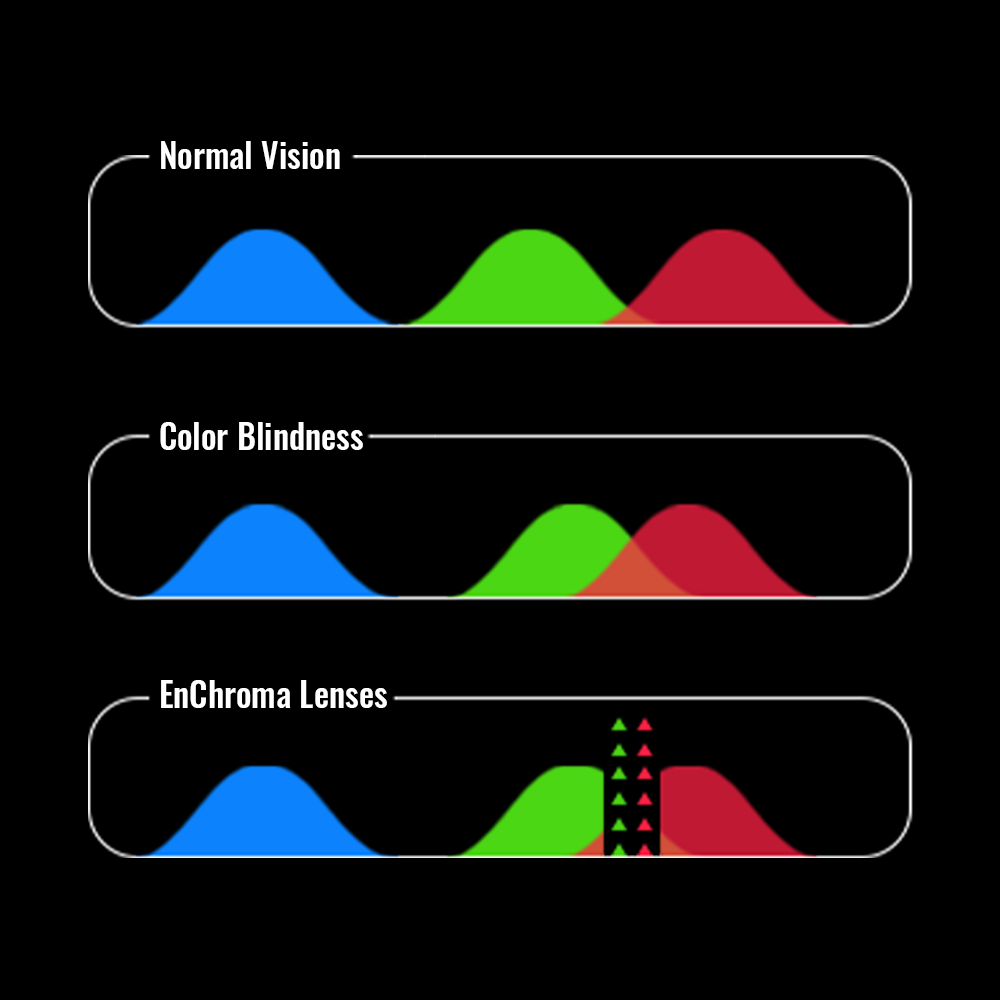
EnChroma lenses do something similar for color. For people with color blindness certain colors overlap and look confusingly alike. These lenses filter down very specific, narrow bits of light that cause this confusion.
By dampening these "problem" light waves, the lenses help the eyes send clearer signals to the brain about reds and greens, signals that more closely resemble the ratio of a person with normal color vision.
It may seem paradoxical that a colorblind person can actually see more color with less information, but that is how it works, much like how turning down some sounds helps you hear music better.
In short: The lenses remove a little bit of the light that causes color confusion, which helps the brain see a wider range of distinct colors.
What is Normal Color Vision?
When light enters the eye, it activates millions of photoreceptor cone cells that can normally detect all the colors of the rainbow. The three types of cone cells, which send signals to your brain, are sensitive to different parts of the visible color spectrum and are generally referred to as red, green and blue cones.
Light is measured by its wavelength in nanometers. Normal color vision is when your cones are most sensitive to 560nm (“Red”), 530nm (“Green”), and 420nm (“Blue”). So that for a given object, like an orange rock, the cones will respond with the expected ratio of activation relative to the other cones. We are adapted to this planet, and this system allows you to see something like 6 million colors.
What is Color Blindness?
80% of color blindness occurs when there is an excessive overlap of the red and green cones in the eye, causing swaths of distinct hues to become indistinguishable (aka “Red-Green Color Blindness”). As a result, those with this kind of color blindness see a fraction of the millions of hues and shades of colors those with normal color vision see. These are the people our glasses can potentially help.
When the green cone is most affected, it is known as Deutan color blindness. When the red cone is, it is known as Protan color blindness.
How Do EnChroma Glasses Work to Help with Color Blindness?
Imagine you're listening to music, and some sounds are too loud and muddy, making it hard to hear all the different instruments clearly. An equalizer (EQ) on a stereo can turn down just those specific muddy sounds. This actually helps you hear the other instruments and details in the music much better.
EnChroma lenses do something similar for color. For people with color blindness certain colors overlap and look confusingly alike. These lenses filter down very specific, narrow bits of light that cause this confusion.
By dampening these "problem" light waves, the lenses help the eyes send clearer signals to the brain about reds and greens, signals that more closely resemble the ratio of a person with normal color vision.
It may seem paradoxical that a colorblind person can actually see more color with less information, but that is how it works, much like how turning down some sounds helps you hear music better.
In short: The lenses remove a little bit of the light that causes color confusion, which helps the brain see a wider range of distinct colors.

01
The Science Behind EnChroma Lens Technology
EnChroma develops optical lens technology that selectively filters out wavelengths of light at the point where this confusion or excessive overlap of color sensitivity occurs. EnChroma lenses alter the signal to the M (Green) and L (Red) photoreceptor cones in such a way that there is a greater color contrast along the so-called “confusion line” for that individual.
02
More Than A Cheap Knockoff
With the application of science, optics, mathematics, advanced neuroscience and more than 10 years of clinical research, EnChroma continues to advance the field of color vision research and bring new products to market that solve unique color deficiency issues. Learn more about the accidental discovery of this revolutionary lens technology.
03
Proven to Stimulate Your Brain’s Color Vision Processing
A groundbreaking new study found EnChroma color blind glasses, which are engineered with technically advanced spectral notch filters, can enhance color vision for those with the most common types of color blindness. Test subjects experienced immediate improvement, which persisted long-term even after subjects stopped wearing the glasses. The researchers also found that wearing the glasses stimulated the color vision processing center of the brain. Learn more
Will EnChroma Glasses Work for Me?
Do EnChroma glasses really work? Color blindness is not a singular condition. It encompasses a range of conditions, from mild to severe, that can cause each person to see color differently. EnChroma glasses are designed to improve color vision of people with forms of anomalous trichromacy, which are estimated to comprise four out of five cases of color blindness.
The most common types are Protanomaly and Deuteranomaly, which are forms of partial red-green color blindness. In the most extreme cases, the complete absence of one of the cone photopigments, called Protanopia or Deuteranopia, are considered dichromats who would see no results from our glasses due to the complete inability to see red and green color differences.
Reduced color discrimination of shades of blue and yellow is called Tritanomaly, or Tritanopia which is not a type of what is commonly referred to as red-green color blindness, but is also a form of color vision deficiency. EnChroma glasses are designed to address most forms of red-green color blindness and are not intended to assist the vision of people with Tritan-type deficiency or Dichromacy where only two of their three color sensing cones are functioning. Fortunately, most cases of color blindness respond well to EnChroma spectral lens technology, enabling the perception of bright, vibrant color. Learn more about types of color blindness and what EnChroma glasses do to help the color blind see color.
If you are unsure whether EnChroma glasses are right for you, consider taking the Enchroma color blind test to identify the type and severity of your color vision deficiency. This online color blind test is quick, convenient, and provides personalized results that can guide your next steps.
Our outdoor lenses in bright sunlight are designed to provide the maximum color impact. See our Lens Guide for more details. To further support accessibility, we also offer a Color Accessibility Program to help organizations and individuals create more inclusive environments for people with color vision deficiency.